Description
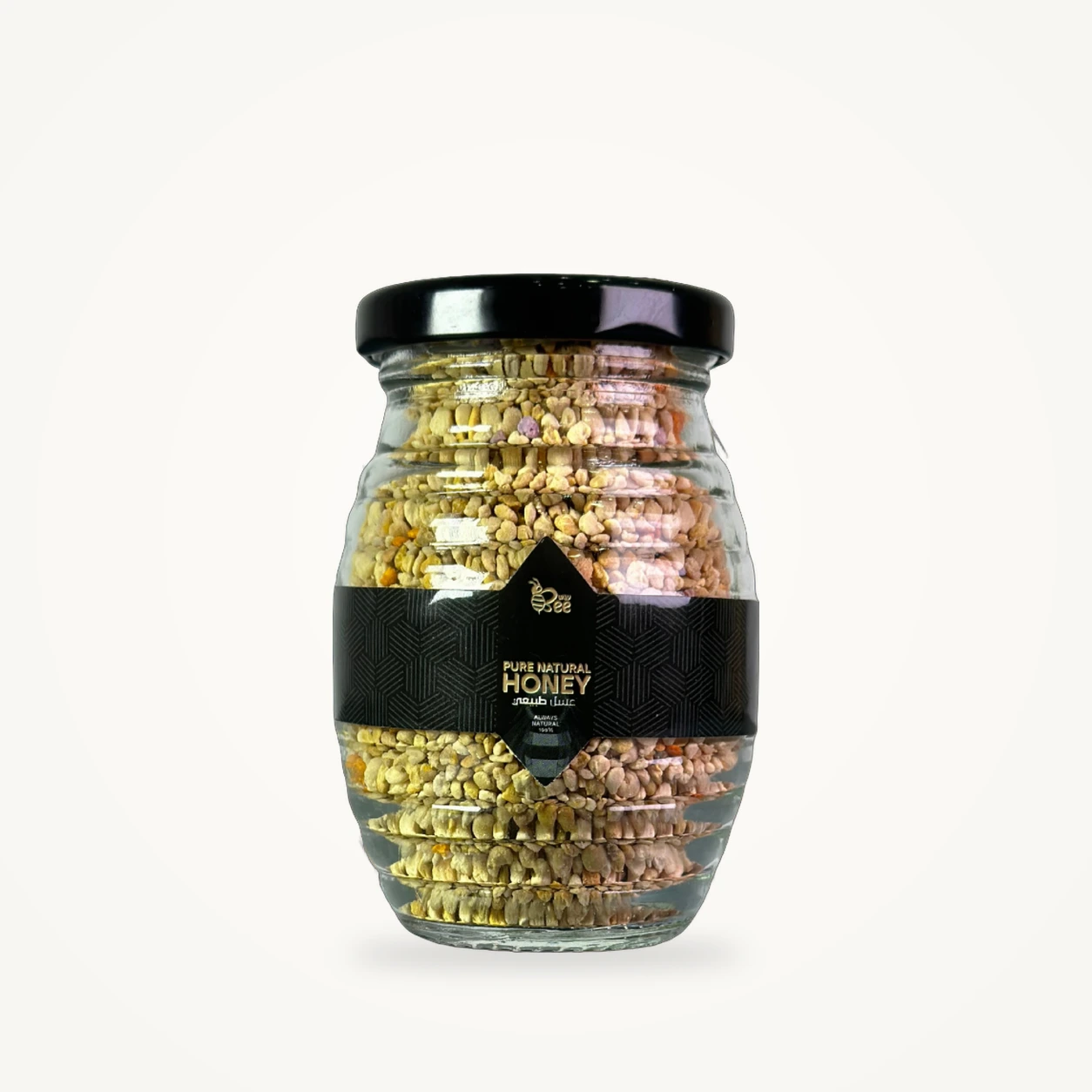
Bee pollen is the colourful granules that bees collect from flowers and carry home on their legs. We collect it from our apiaries in different regions of Jordan, so its colour varies with the flowers of each season. It is a rich natural food, not a medicine, and here we explain what it contains and what studies say about it, without exaggeration. We sell it fresh and frozen, in two sizes: 125 g and 250 g.
What is bee pollen?
Pollen is the male cells of plants. The bee gathers it from flowers, mixes it with a little nectar and saliva, and forms small pellets that it carries on its hind legs. In the hive, pollen is the main source of protein for the larvae and young bees.
How do we collect it?
- We fit a pollen trap at the hive entrance: a grid with small holes that the bees pass through, so the pellets drop off their legs into a tray below.
- We empty the tray regularly and take only a small share, so the hive’s food is not affected.
- We clean it, pack it and freeze it straight away.
What does it contain?
According to the scientific review that set quality standards for bee pollen, every 100 g of dried pollen contains roughly:
| Component | Amount (g per 100 g dried) |
|---|---|
| Sugars and carbohydrates | 13 – 55 |
| Protein | 10 – 40 |
| Fibre | 0.3 – 20 |
| Fat | 1 – 13 |
| Minerals (ash) | 2 – 6 |
The shares vary a lot with the flowers, season and region. Fresh pollen contains more water, about 20 – 30 g per 100 g.
What do studies say?
- Its main value is nutritional: a natural source of protein, sugars and fibre, with small amounts of vitamins and minerals.
- Human studies are few and small: a 2022 review of clinical trials on bee pollen found that most of them were on prostate symptoms using processed pollen extracts, not the pollen itself, and most were small or had no control group.
How to use it
- Start with half a teaspoon a day for the first week, to make sure you are not sensitive to it.
- After that you can take one to two teaspoons a day.
- Eat it with honey, yoghurt, juice or oats, or chew it on its own: it tastes sweet with a floral note.
- Don’t cook it or add it to very hot food, as heat affects its components.
How to store it
Fresh pollen is high in moisture, so keep it in the freezer as soon as it arrives. Take what you need with a clean, dry spoon and put the jar straight back in the freezer.
Good to know
- If you are allergic to flower pollen or to bee products, start with a very small amount or ask your doctor first. Some people can react to it, and rarely the reaction is severe.
- If you take a blood thinner such as warfarin, ask your doctor before starting. In a documented case, a patient on warfarin had a rise in his clotting test after starting bee pollen.
- During pregnancy and breastfeeding: there are not enough studies, so it’s best to ask your doctor.
Frequently asked questions
Does bee pollen cause weight gain?
The daily amount is small (one or two teaspoons), so it adds few calories.
Is it suitable for children?
In a very small amount, once you are sure they are not sensitive to bee products.
Why are the colours different?
Each colour comes from a different flower. The variety shows it comes from many wild flowers.
What is the difference between bee pollen and bee bread?
Bee bread is pollen that the bees have stored inside the hive and fermented. Bee pollen is the fresh pellets before they are stored.
Scientific references
- Campos MGR, et al. Pollen composition and standardisation of analytical methods. Journal of Apicultural Research. 2008;47(2):156–163. Source
- Algethami JS, et al. Bee Pollen: Clinical Trials and Patent Applications. Nutrients. 2022;14(14):2858. Source
- Komosinska-Vassev K, et al. Bee Pollen: Chemical Composition and Therapeutic Application. Evid Based Complement Alternat Med. 2015;2015:297425. Source
- Hurren KM, Lewis CL. Probable interaction between warfarin and bee pollen. Am J Health-Syst Pharm. 2010;67:2034–2037.
The information on this page is for general education and does not replace medical advice.



Reviews
There are no reviews yet.